by Mariana Barillas
Space frames are seen in massive modern marvels such as the Louvre Pyramid and Las Vegas Sphere. These grid-like structural systems are highly favored for strength, versatility, and sustainability but they can be too costly and complex on a smaller scale. The School of Architecture and Allied Arts seeks to change that.
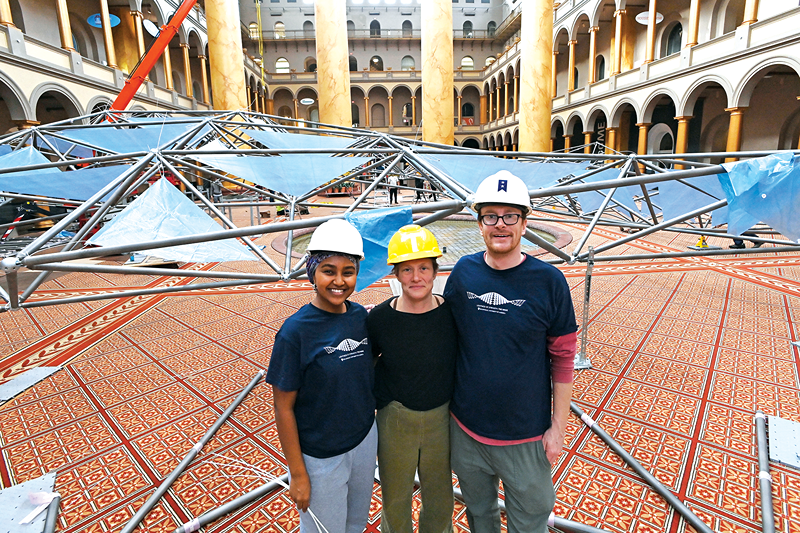
This past fall semester and into the winter season, Architecture Associate Professor Tonya Ohnstad led an effort to construct “The Wave.” This prototype is a first-of-its-kind structural system, developed with graduate student Dave Stephen in collaboration with Mike Graves of industry leader DSI Spaceframes.
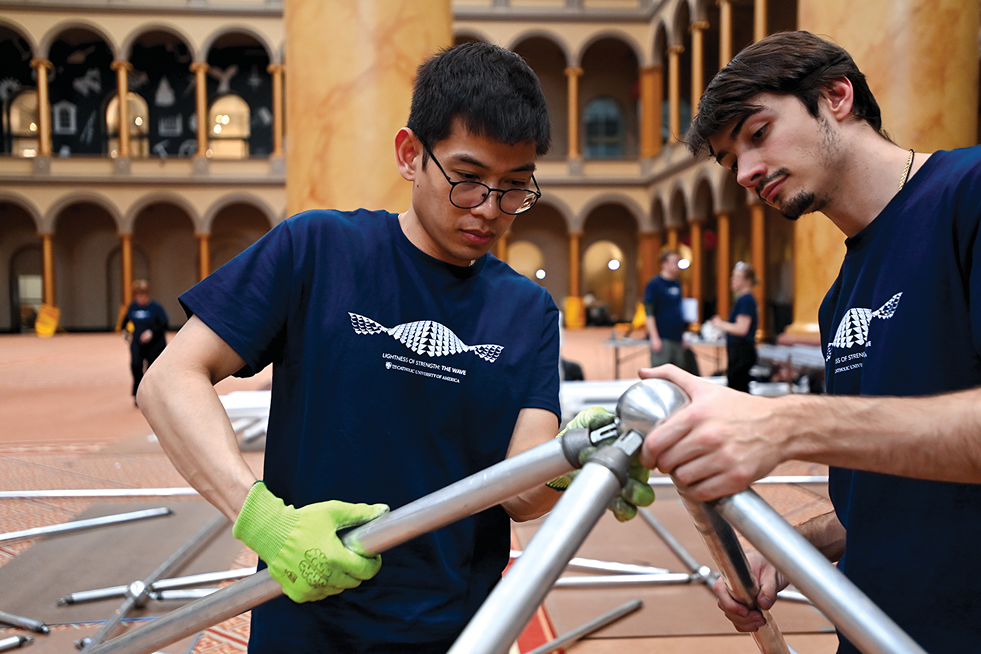
The patent-pending technology involves threading a tensioned cable through each strut, a technique that combines compression and tension to create a resilient aluminum structure that is four times lighter than a steel equivalent. The goal is a recyclable and resource-efficient method to mainstream space frames to a wider range of architectural projects.
“This new approach would enable spaceframe design and construction to be more sustainable, efficient, flexible, and affordable,” said Ohnstad.
She led a team of two dozen architecture students and outside collaborators to erect the exhibit “Lightness of Strength: The Wave” in the National Building Museum’s Great Hall, a premier venue for ambitious architecture and engineering experiments as immersive experiences. The theme of durability and fluidity was reinforced by sheets of Dyneema — the world’s strongest fabric, donated by the producer — stretched between each 3D triangle to help evoke a current captured in time.
“To be invited to use this space not just as a venue, but as a laboratory, is a real honor,” said Ohnstad, as she stood under the silent swell of steel upon the completion of the multiyear collaboration with the National Building Museum.
Just as each strut shares the load of the project, team members supported each other as they worked to realize a first-of-its-kind structure from start to finish. Things didn’t always go as planned: they faced a tight assembly timeline in the museum’s hall, and an unexpected shift in materials availability required late-stage design changes.
“There were a lot of challenges,” said Ohnstad. “But to see people come together and problem-solve was just magical.”
Upon completion in January, the museum opened its doors for an after-hours celebration, where University community members got an up-close look at the sheer scope of the project. Visitors relaxed under the awning of the structure, listened to live music from Music Professor Andrew Earle Simpson and University faculty-led jazz group The Earles, got a deep dive into the construction at a custom-built exhibition gazebo, and enjoyed indoor ice gliding on a rink installed alongside the Wave.
The completion of the project is a dream come true for Eleleta “Lou” Seyoum, M.A. 2025, a student lead for The Wave. She looked up to scan each strut as she shared her detailed knowledge of the structure with an infectious enthusiasm.
“It doesn’t feel real. … I remember the very first sketch and the first 3D print. Seeing it all put together and then people take pictures of it, it’s so amazing,” said Seyoum.
Architecture and Allied Arts Dean Mark Ferguson said the project is a pedagogical tool to train students for life after graduation in one of the nation’s top locations for architects.
“Washington, D.C., has a very vibrant professional community. This project engages us with the community by working outside classroom walls,” said Ferguson. “It gives [students]
a taste of the real world before they’re completely immersed in the real world.”
The Wave was supported by American Institute of Architects (AIA), Amazon, Architectural Systems, DSI Spaceframes, Dyneema, Harmon, Hydro, United Rentals, and the Graves Family.