By Mariana Barillas
Violinist and Ukrainian refugee Roman Velychko, Class of 2028, speaks about music the way he plays it — with confidence, warmth, and a complete lack of pretense.
He escaped a war zone in 2022, completed the Julliard School’s Pre-College Program, and won a Carnegie Hall Ukrainian music performance competition, twice in a row.
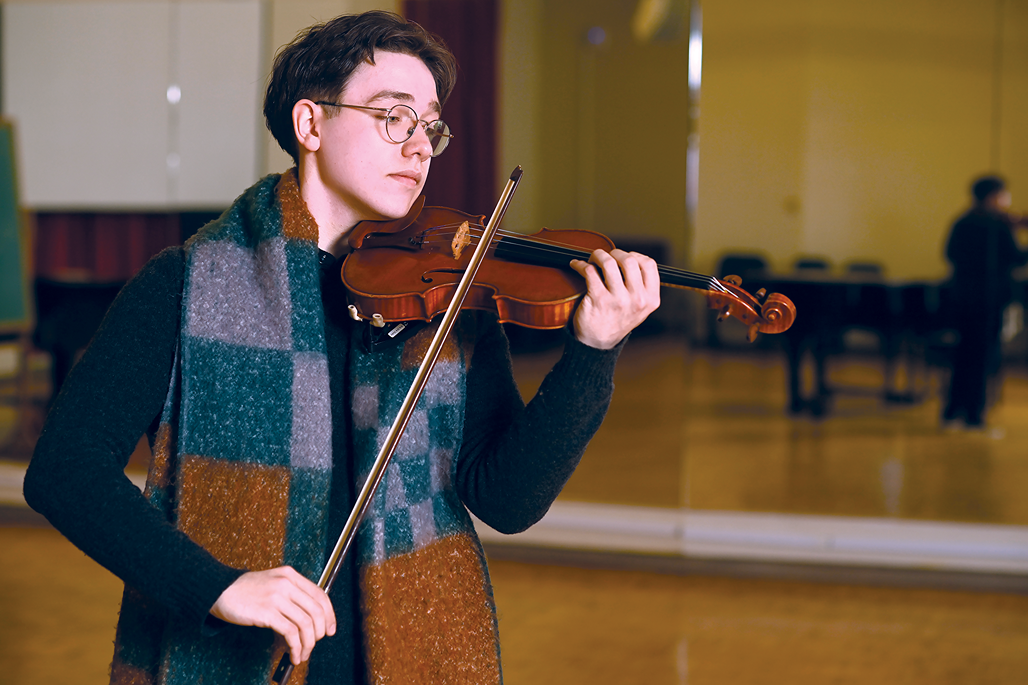
“Music brings comfort in tough times, it takes you into another world away from your troubles,” Roman said as he practiced in the Rome School of Performing Arts building for his upcoming orchestral performances. He is pursuing a Bachelor of Music with a concentration in music performance (strings).
Roman plucks the strings of his violin, handcrafted by local master Howard Needham. It is on loan as a gift from a donor secured by his instructor at the University, Alessandra Cuffaro. He eagerly shares the instrument’s history, construction, and sound — comparing it to his 19th-century French-made violin. In this casual conversation, he displays a depth of knowledge matched only by his infectious enthusiasm for his musical craft.
Behind the Riff
He plays Myroslav Skoryk’s “Melody in A Minor,” a spiritual national anthem for Ukraine, as he shares his story of survival, which began when he was only 14 years old. Both his parents are classical musicians, but it was during the prolonged siege of his home city of Chernihiv that he fully committed himself to violin as
his vocation.
For two months in the winter of 2022, after the Russian invasion of Ukraine, he huddled with his parents in their basement without heat or running water. He remembers the sound of sirens, ballistic missile blasts, the hum of drones, and the eerie quiet of once bustling downtown streets. He filled the uncertain silence in between attacks by playing his mother’s violin.
After the siege ended, they left the largely destroyed city to live with relatives in Western Ukraine. Roman had a visa to the United States from a previous visit to see his aunt and her family, so he flew alone to Washington, D.C., in 2022 to live with them.
Measures and Scores
Roman speaks of the war in a measured manner, saying no more than what needs to be said. He plays with passion, but he isn’t playing for sympathy. He wants to be treated “just like any other student.” And he’s determined to make his own way.
He works weekends to support his studies at the University while taking public transit each day to campus from his aunt’s house on Capitol Hill, where he’s lived since leaving Ukraine. It’s time away from practice, but it’s a step up from his old commute: For two years of high school, he’d wake up at 2:30 a.m. to catch a bus from Union Station to New York City for a full day of music training at Julliard before returning home the same evening.
When Roman was applying to colleges, his joyful work ethic struck a chord with the Rome School’s maestro, Simeone Tartaglione, associate professor of practice, conductor of the University orchestra and orchestral instruments, and conducting area head. Tartaglione helped Roman find scholarship funding and spotted a talent for conducting, which he is developing, as the University is one of the few institutions to offer a conducting emphasis.
“His violin playing is excellent, his leadership secure and gentle,” said Tartaglione. “He is so positive and fills the hallways with laughter.”
A Lasting Resonance
In the United States, Roman has found a new rhythm of life as he composes his future.
“I love the openness of Americans, it is easy to find a connection,” said Roman. “I’m so happy at Catholic University. I have great teachers and the best of friends.”
And in the United States, he has found freedom, a place to flourish, play music and study, and a chance to carve out a new home for himself. His story is like the beginning of so many stories of immigrant families that continue to shape the ever-changing face of our nation.