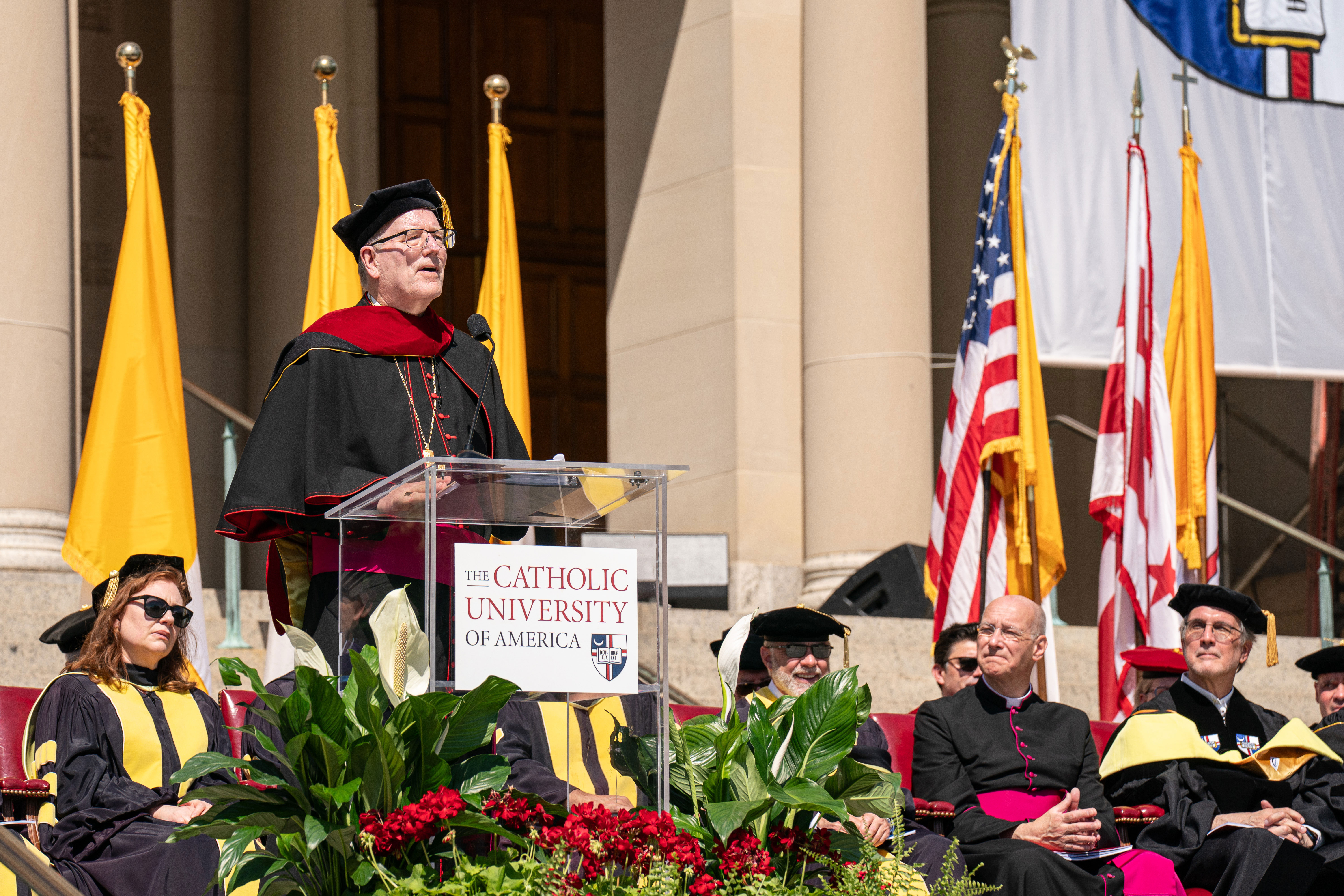
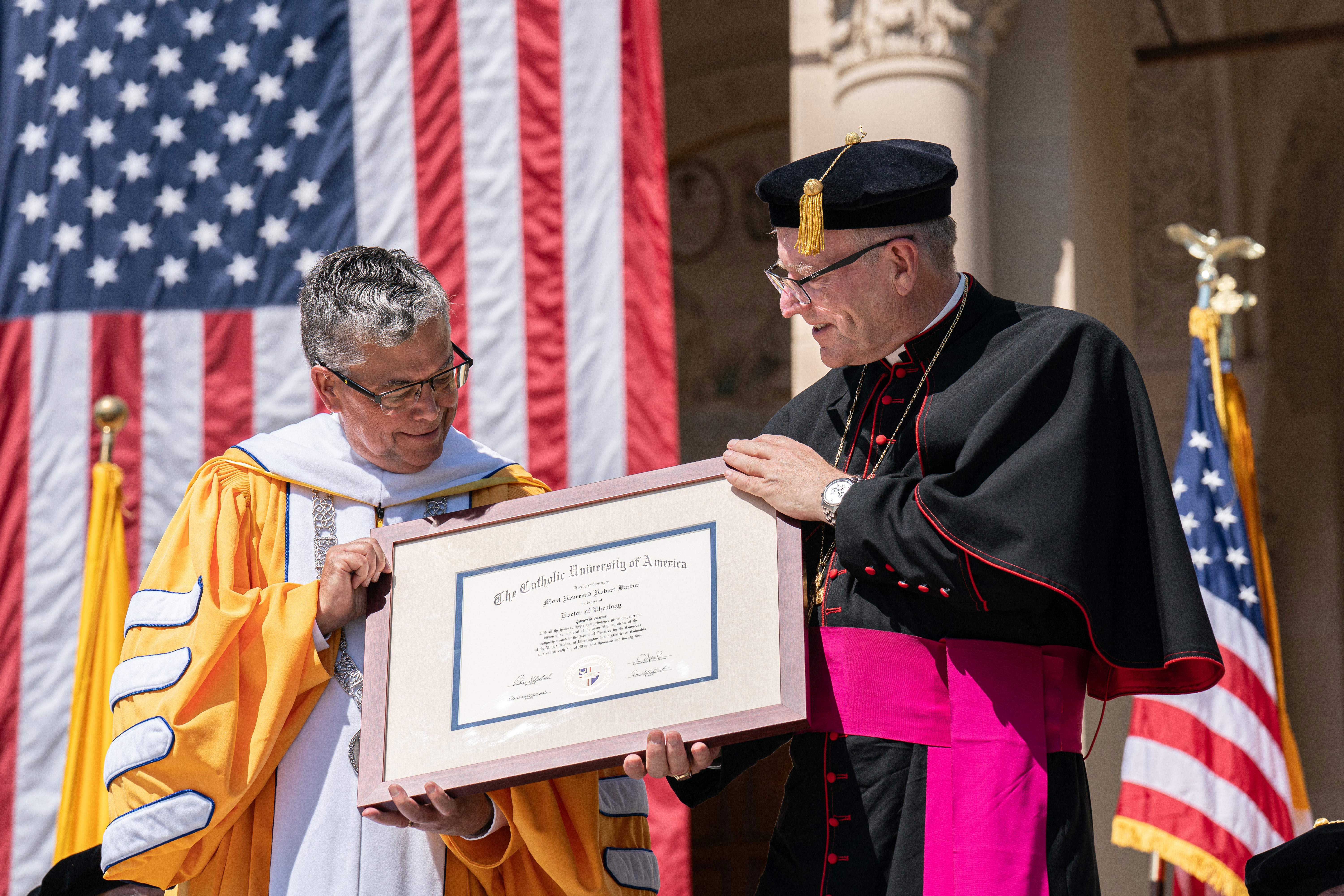
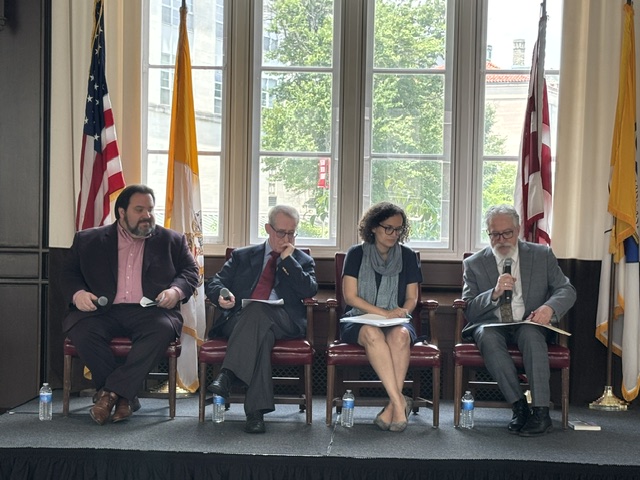
Bishop Robert Barron, bishop of the Diocese of Winona–Rochester and founder of Word on Fire, delivered the 2025 University Commencement address on Saturday, May 17. The text of his remarks follows immediately below.
President Kilpatrick, fellow members of the Catholic University Board of Trustees, dear faculty and students, thank you for the great honor you have bestowed on me today. May I say as I begin, that it is wonderful that this is the first Catholic University graduation to take place during the Papacy of Leo XIV, who took his papal name in tribute to Leo XIII, the Pope who presided over the establishment of this great institution. To Pope Leo, ad multos annos!
Fellow graduates of the Class of 2025, I sat exactly where you are sitting forty-three years ago. I know it’s a cliché to say it, but it seems like six months ago. It was a bright, sunny day, and the commencement speaker was Frank Reynolds. Most of you probably don’t remember him, but he was the anchorman for the national ABC news, a very well-known personality at the time. I will confess to recalling not a word of what he said, but I remember the moment, very well. It felt joyful, exciting, full of future promise. I hope all of you feel that way today. I want to offer, of course, a word of very sincere congratulation to my fellow graduates, but I also want to thank with all my heart your parents, friends, teachers, and mentors who have brought you to this day of celebration. God bless all of you.
My years at Catholic University, where I studied philosophy, corresponded to some extraordinary events in the wider world. Ronald Reagan was elected president during my time here, and I had the opportunity to attend his inauguration on an unusually beautiful January day. The Iranian hostages were released around that time, and I took part in the celebration on the Mall. Just a few months after his inauguration, and as I was preparing for my comprehensive exams, the president was shot, and Pope John Paul II was nearly assassinated just a few months later. But while all of this upheaval and excitement was proceeding in the outside world, I was largely preoccupied with my studies, which amounted to an opening up of a higher world. For I was a student of philosophy. Plato speaks of the escape from the cave, which is to say, from the world of ordinary experience, in order to find a world of mathematical and philosophical truth, a dimension of reality that does not change and that brings us closer to God.

Philosophy, in imitation of Plato, has inquired into questions such as the nature of the good life, the ultimate origin of all things, the meaning of truth, the nature of justice. These are, in themselves, perfectly useless questions and those who entertain them are useless persons. I mean both of these as a compliment. One of the most important truths I learned from Aristotle—and I learned it here—is that the liberal arts, which is to say, those that are liberi, free from practicality, are higher than the practical arts, for they are focused on things that are good in themselves. So, knowing how to fix a car is a useful art—and a most important one—for it is subordinated to the good of driving the car; and surgery is a useful art, for it is subordinated to the good of the health of the body. Politics is a useful study, but it is in service of something higher, namely, justice. Why do we drive cars at all and what do we do with our healthy bodies? Why should we choose this candidate or that? Neither mechanics nor biology nor political science can answer those questions. They can be answered only by the useless study, which enquires into issues of truth, goodness, and beauty. I consider my years of philosophical study here, under a series of masters, one of the great privileges of my life. The wonderfully useless years that I spent here set the tone for the rest of my life and career.