What experience inspired you to write The One and the Ninety-Nine?
It started on a road in Ireland. I was driving my parents around the Dingle Peninsula when my father, who’d gone quiet in the back seat, asked me to pull over and got sick on the side of a mountain pass. I didn’t know it yet, but that was the beginning of his decline with Alzheimer’s disease, which is a thread that runs through the book. Over the next few years, I helped care for him as dementia took hold, and I ended up back in my childhood home in Michigan—a house that had quietly fallen apart while I was off building a life somewhere else.
Caregiving has a way of bringing a very fundamental question to the surface: How do you live out a personal vocation while staying bound to the people you love? That’s the tension at the heart of the book. It’s basically a book exploring a philosophy and theology of communion in the modern world—specifically, what allows for a communion of free persons united in love, not ideology or conformity.
At the same time, I was watching a colder version of my personal tension play out everywhere online, where people form and deform their sense of who they are in real time, according to whatever the crowd rewards. As I was adjusting to my new life as a caregiver—which was asking me to access parts of myself that I didn’t know existed—I was simultaneously seeing and being pulled toward superficial engagement online. Technology has made the quest for real community harder than ever.
If it’s hard for me, it has to be extremely hard for a young person today—for example, the kind of person who enters this university as a freshman. I’m deeply invested in helping others navigate the tension between who they are created to be and the various communities they inhabit throughout their lives.
Who should read it?
Anyone who has ever gone along to get along and felt something in themselves die along the way. That’s most of us, I think. But I wrote The One and the Ninety-Nine with particular people in mind: the person inside an institution who feels the pressure to conform and senses what it’s costing him; the parent trying to raise a kid who can think and act for herself; the young person assembling an identity under constant comparison on social media; the leader responsible for both the individual and the whole. It isn’t a business book. It isn’t self-help. It’s a book for people who want to understand how a personal vocation can be lived in a world that might not understand it, and might even be actively hostile to your living it out.
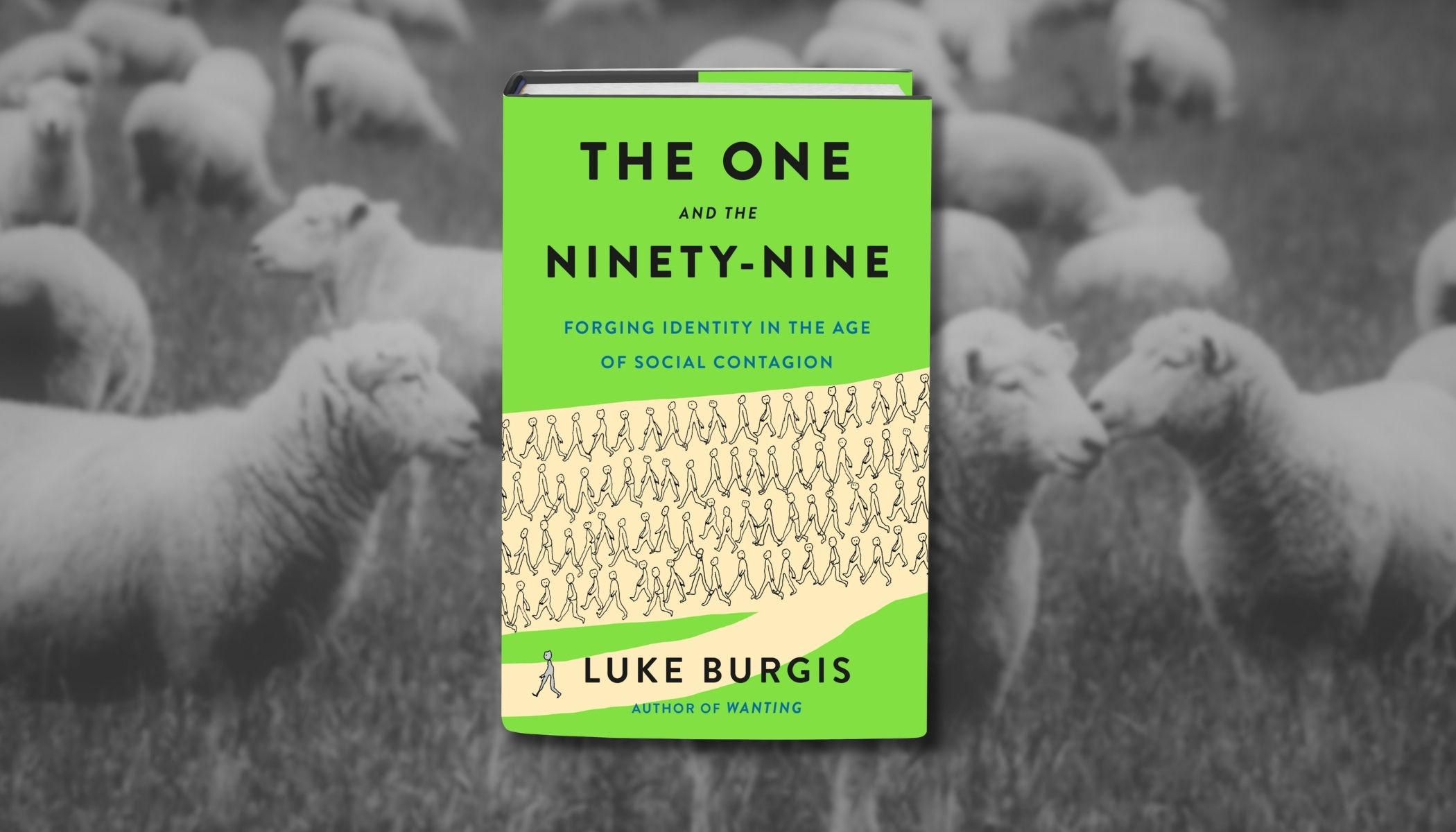
The title comes from one of Jesus’ best-known parables. What does “the one and the ninety-nine” mean in today’s context?
In the parable, the shepherd leaves ninety-nine sheep to go after the one that wandered off. By any reasonable management logic, that’s insane—you don’t risk the aggregate for the outlier. But that’s exactly the point. Each person is irreplaceable, not interchangeable.
We live under enormous pressure to become the ninety-nine: a face in the crowd, a data point, a self that is stitched together from whatever pressures and expectations are put on us from time to time. The platforms and institutions that shape our lives are built to treat us as a mass, because a mass is easier to predict and to move. The parable shows another way. It is precisely in seeking what is lost that we find the answers we’re looking for.
Your first book, Wanting, examined the forces of desire and imitation. How does this book build on — or depart from — your earlier work?
Wanting was a diagnosis. Drawing on the Catholic social theorist René Girard, it showed that we don’t invent most of our desires—we catch them from the people and crowds around us. Readers found that clarifying and a little disturbing, because once you see mimetic desire you can’t unsee it. The obvious next question is: So what do I do? If I’m that porous to other people’s wanting, how do I become someone with a center, a ‘solid self,’ of my own?
That’s the theme of this book. Wanting was about desire; this one is about identity. It moves from naming the problem to the work of becoming what I call a solid self, instead of a pseudo-self—someone who can belong to a group without fusing with it.
Where Wanting leaned heavily on Girard, this book is a much more sweeping analysis of how to understand the human person in the world today as someone constituted by relationships — with God and with one another. The first book asked what we want. This book asks who we’re becoming through the associations that we form.
Alexis de Tocqueville once wrote that “In democratic countries the science of association is the mother science; the progress of all the others depends on the progress of that one.” I’m very interested in the science—and the art—of association. I’m interested in relational ontology, to use a more theological phrase. In other words, how do our relationships contribute to our being?
What challenge does The One and the Ninety-Nine pose to universities and institutions seeking to care for both individuals and the whole?
Institutions feel the same tension a person does—between belonging and differentiation—and they tend to resolve it badly for the same reason. The temptation is always to optimize for the ninety-nine: the smooth-running whole, the clean metrics, the version of the institution that’s easy to explain to itself. What gets sacrificed is usually the one: the unique and unrepeatable vocation, the prophetic voice, the lost, the marginalized.
Social contagion is rampant inside most institutions, where the pull to conform shows up dressed as collegiality. An institution that truly cares for both the individual and the whole has to do the harder thing: protect the freedom to disagree without rupturing the relationship, tolerate friction instead of smoothing it away, refuse conformity even when conformity is cheaper. A Catholic institution has an advantage here that it often forgets it has. The conviction that each person is unrepeatable and has infinite dignity gives it great reasons, not just good feelings, for refusing to trade the one for the ninety-nine.
If this book could spark one conversation across the Catholic University campus, what would you hope people discuss?
This past June, Santiago Schnell—the provost of Dartmouth and a former dean at Notre Dame—stood in front of the U.S. bishops and told them that Catholic universities are becoming secularized through imitation, chasing the same rankings and prestige as everyone else. He challenged them to help Catholic education move, in his phrase, from imitation to imagination.
I’d take that personally, because Schnell was describing, at the scale of an institution, the exact dynamic I’ve spent two books writing about. A university that merely imitates is a pseudo-self writ large, its sense of itself borrowed from what its competitors are doing instead of drawn from its own convictions. The conversation I’m after is easy to state, but very hard to have: Are we forming solid selves and a solid institution, a place with its own genius loci, to borrow Newman’s phrase, or are we producing impressive imitators?
Due to AI, there’s an edge to this now that there wasn’t a generation ago. The medievals distinguished ratio, the reasoning that follows a procedure, from intellectus, the direct grasp of what’s really there. A machine can do the first but will never do the second. If a Catholic university can’t say clearly which one it exists to form, it has already begun imitating the machine.
One of the many reasons that I’m proud to be a part of this University is that it is attempting to live out its Catholic identity—which is the institutional form of a “solid self,” as I write about extensively in the book—and isn’t overly concerned with molding itself to cultural expectations.
But, of course, the solid and pseudo-selves exist on a continuum, and the temptation is always there. In what ways and in which situations are we solid, and where are we slipping into the pseudo? That’s the conversation we should be having about institutions, just as we should be having it about ourselves and our families.