Can students disagree about politics without turning into enemies?
Through the implementation of various programs that encourage student dialogue, Catholic University’s Department of Politics aims to diminish political polarization on campus — in the classroom, in its research focus, and through student training. These efforts reflect Catholic social teaching, which emphasizes human dignity, dialogue, and the search for the common good.
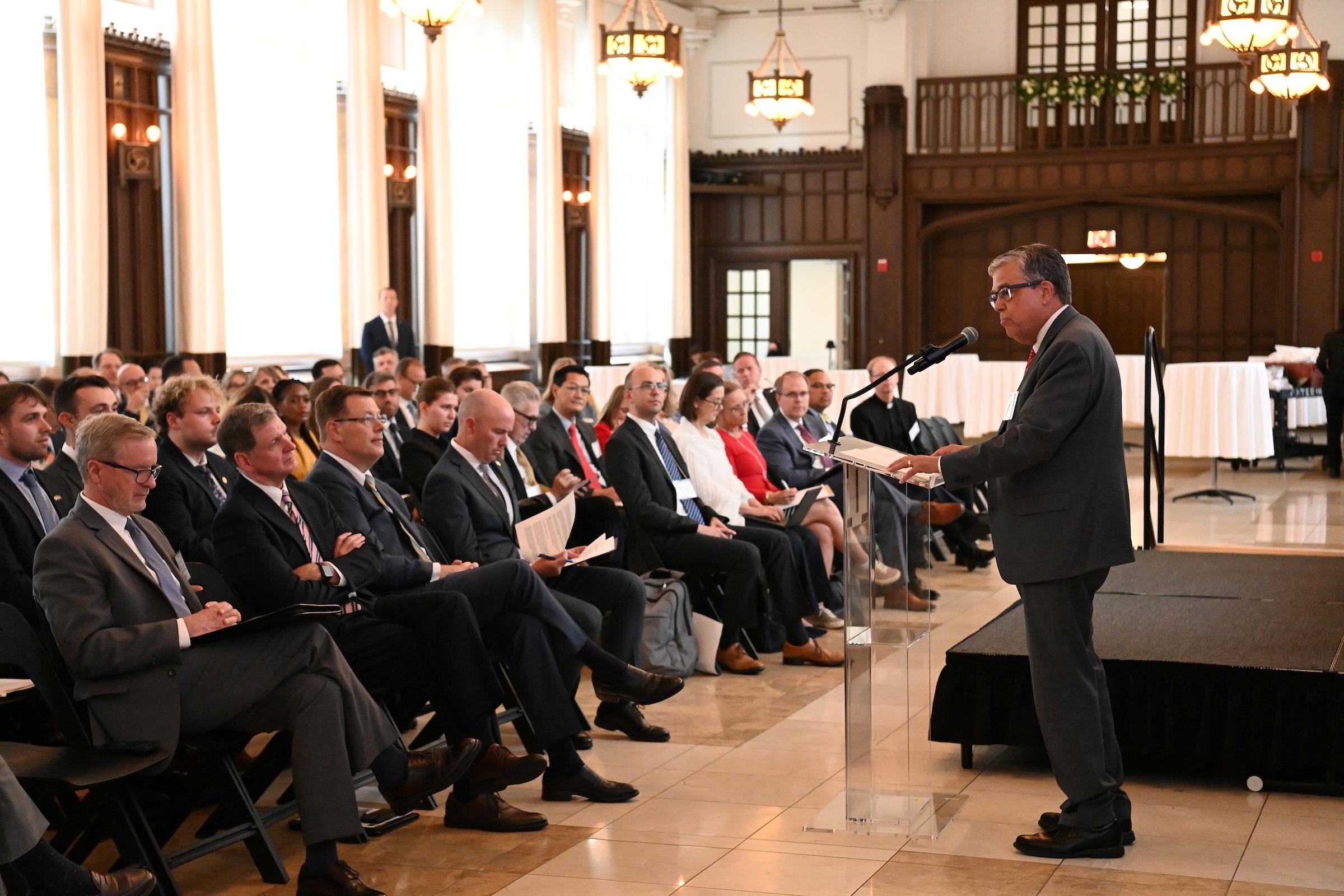
“The Founding Fathers never wanted political parties; they warned against them and did not include them in the Constitution,” said Matthew Green, professor of politics and recent winner of the American Political Science Association’s prestigious Barbara Sinclair Lecture Award. “Had they known they were going to emerge anyway and eventually help presidents expand their formal powers, they might have written the Constitution very differently.”
Green delivered these remarks during the University’s inaugural President’s Day lecture on February 19, 2026. In his lecture, he urged Congress to adopt a reform agenda that could help restore Constitutional checks and balances and limit the harm caused by extreme polarization. Such reforms could include adding new statutory limits on the president’s exercise of power and opening up the legislative process to more lawmakers from both parties.
Taking Action
Students have taken an active role in combating polarization and incivility in American culture, with the help of new politics courses, such as “AI Policy and Ethics” and “Political Polarization.”
These courses were developed through a grant that Maryann Cusimano Love, chair (at time of publication) and associate professor of politics, received from Duke University as part of its Project on Civil Discourse. Convening with experts from around the country, faculty shared best practices for how to teach hot-button issues and lead classroom discussion with students in a civil, rational way.
Student projects generated from these courses include everything from organizing events co-sponsored between College Democrats and College Republicans to meeting with AI creators and encouraging the development and use of AI to increase social cohesion, rather than monetize extremism.
Graduate student Grace Connors was selected as a summer fellow at the University of Notre Dame’s Kroc Institute of Peacebuilding, where she examined how the AI algorithms driving social media exacerbate polarization. She contends that AI, social media algorithms, and political incentives often magnify the loudest and most extreme voices — but they don’t have to. In fact, she found different ways that AI can be used to strengthen communities, through public safety initiatives or administrative assistance for small businesses, for example.
Learning Real Dialogue
Some students say political discussions in class can feel risky, worrying that such conversations will descend into mere bickering. In response, they have partnered with organizations like Braver Angels, designed to create spaces where disagreement can happen without hostility.
The program works to build community and help establish friendships, understanding, and goodwill across partisan and other identity differences. Braver Angels aims to serve as “a citizens’ organization uniting ‘red and blue Americans’ to depolarize America, find common ground, and strengthen our democratic republic.”
“It’s a great opportunity to build relation-ships and dialogue across the kind of polarized atmosphere in our country right now, and give students the skills to continue to have these kinds of respectful civic dialogue going forward,” said Marta Bystrowska, B.A. 2026. “What’s so unique about Braver Angels is that it is experiential. You can be taught, you can be told, you can see a presentation of how civil discourse works, but I think it’s one thing to learn about it and then another to experience it firsthand. That experience of actually engaging in a civil discourse benefits students greatly and then allows us to be able to apply it outside of our program, in all aspects of life.”
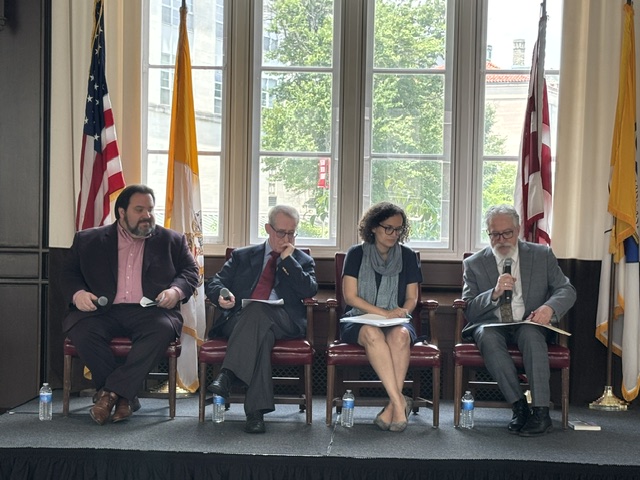
One such exercise this past semester was the campus debate “Should We Abolish ICE?” Sponsored by the Politics and Global Studies departments, Braver Angels, College Democrats and College Republicans, and the Alexander Hamilton Society, the event drew hundreds of students together to talk about a polarizing issue in America today. The event’s goal was to provide a unique debate format moderated by
a panel. Students took turns sharing their ideas and answering questions, fostering dialogue over arguments. The overall objective was to foster respect and civil dialogue across party lines, as an educational experience and exercise in civic debate and friendship.
“I think a liberal arts education can only properly flourish if students feel welcome to speak their minds and have that freedom of expression, and can understand that it doesn’t have to just lead to gridlock or anger or polarization,” Bystrowska said. “We want to empower students and give them the skills they need, so they don’t feel like they have to be quiet in their classes [or in public forums] but can engage positively with one another.”
In a social media post about the event, President Peter Kilpatrick wrote: “Democracy runs on persuasion. And persuasion depends on seeing the good faith behind opposing viewpoints. The sneering, scolding tone of American politics today is great for politicians, fundraising, and cable news ratings, but terrible for the country … If political professionals have abandoned civil, empathetic debate, then it’s up to young Americans to develop those crucial democratic skills for themselves. And it’s up to universities to prepare their students for the rigors of virtuous citizenship in a divided era. Our students — steeped in Church teaching about human dignity and flourishing — are uniquely equipped to help elevate our public discourse in the future.”
Character and the Common Good
Politics faculty also combat polarization through participation in the Cultivating Virtue initiative, sponsored by the Wake Forest Educating Character grant. Through this $1 million grant to Catholic University, students are invited to practice virtues, not merely study them.
As part of the Cultivating Virtues program, Michael Promisel, assistant professor of politics, created a new course called Priests, Prophets, and Kings: Leadership in the Catholic Tradition. This course explores the history, guiding principles, and animating virtues of leadership in the Catholic tradition — namely, prudence, humility, magnanimity, and docility. Through the study of scripture, Church social teaching, the lives of saints, and simulations of prudential decision-making, the class aims to understand what leadership is in theory and the best methods for cultivating its practice.

Other politics classes participating in the program, such as Global Issues and AI Policy, offer students opportunities to grow in virtues such as honesty, friendliness, empathy, and teamwork — all virtues that advance civic behavior and combat destructive polarization.
What’s at Stake
As the United States celebrates its 250th anniversary, the question facing many campuses is whether political disagreement will deepen divisions or strengthen democracy. And at Catholic University, faculty and students are betting that learning how to listen may be just as important as learning how to argue.
There has been some evidence of democratic decline in some of the longest-standing most-developed democracies like the United States, the oldest constitutional democracy on the planet.
At this moment, Andrew Yeo, professor of politics, and his research on South Korean politics seems critical, as South Korea provides a good model of how a developed democracy can “bounce back” from possible decline.
When Pope Leo XIII chartered The Catholic University of America, he urged the University to “give the Republic its best citizens.” As we mark 250 years of the United States, our students and faculty are personally invested in building up educated, articulate citizens who can defend and discuss the greatest formative issues of our time.