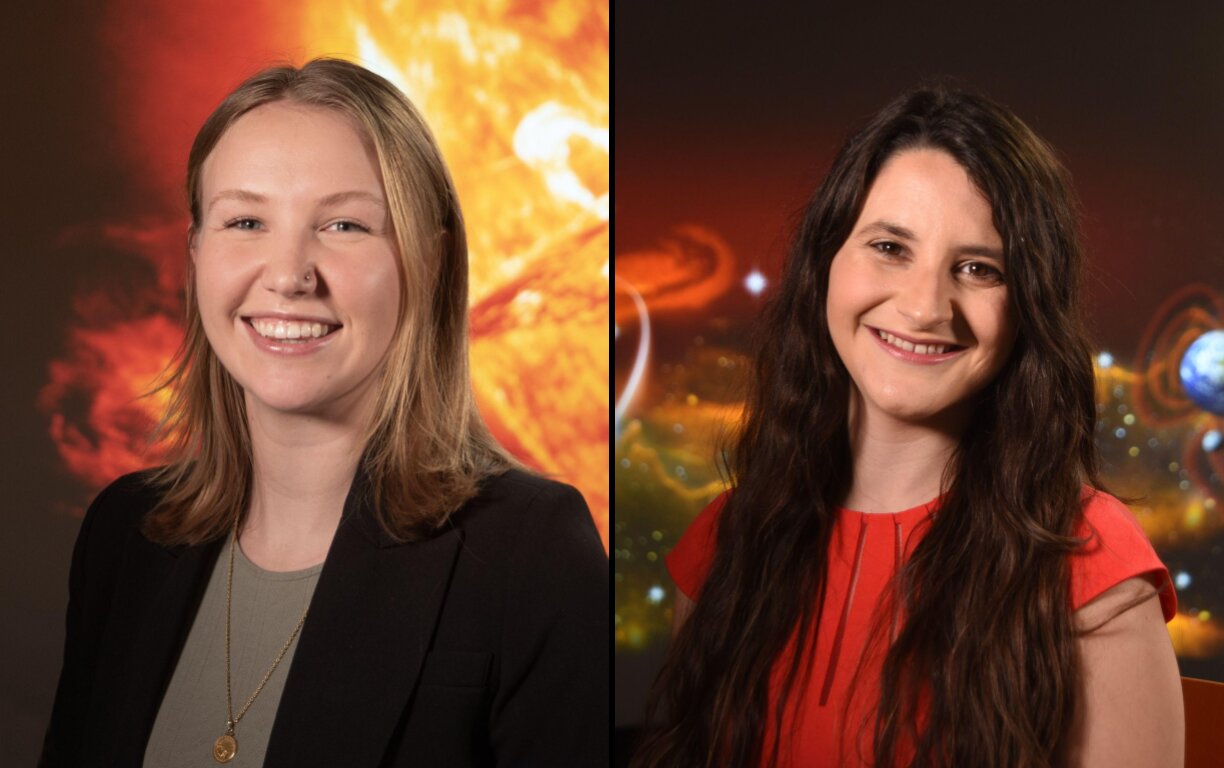
Throughout the month of July, Tanja Horn, professor in The Catholic University of America’s nuclear physics group, College of Engineering, Physics, and Computing, has landed more than $1 million in funding for two research projects that integrate artificial intelligence (AI) technology into scientific data collection and analysis.
DoE GENESIS Mission
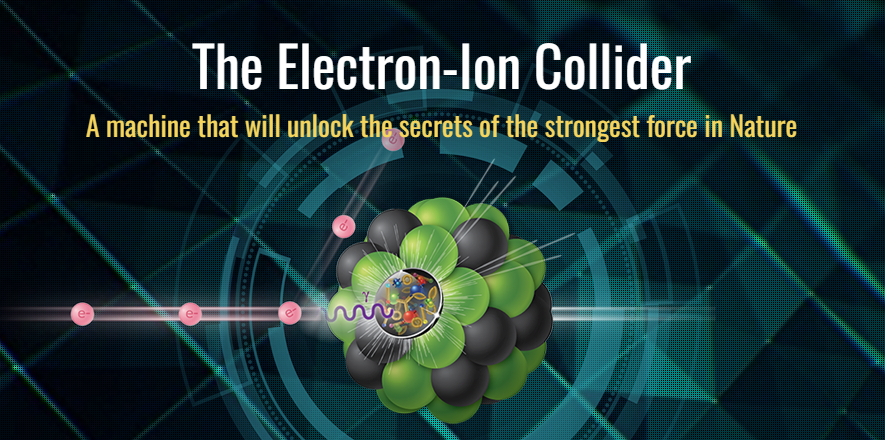
On July 22, 2026, the U.S. Department of Energy’s GENESIS Mission awarded $300,000 to Horn and co-investigators Dominick Rizk, assistant professor of computer science at Catholic University, and Jefferson Lab’s Dmitry Romanov, to develop an AI-integrated solution that will redefine scientific discovery for DOE facilities, such as the Electron-Ion Collider. Intelligent, physics-aware AI will be embedded directly into data streams produced by these high-rate experimental environments.
According to Horn, the collider will generate continuous detector data streams approaching 100 gigabits per second. At that speed, massive amounts of data are produced. The new approach means rare physics signals embedded within the stream of data can be identified in real-time, avoiding data pile-ups.
“Existing trigger systems and machine learning [ML] approaches are not deployable at this scale, due to limited adaptability, poor scalability, and lack of integration with physics constraints,” Horn writes in the project abstract.

Her research team will seek to remove the data bottleneck by employing intelligent, physics-aware AI directly into the data stream. The methodologies will be applicable to other DOE mission areas that involve similar high speed, data-intensive environments.
Horn says: "This award leverages our team's expertise in hadron physics research at the DOE National Laboratories and enhances it with cutting-edge AI capabilities."
The GENESIS Mission is a priority national initiative focused on developing and demonstrating AI-enabled scientific workflows, accelerating breakthroughs in energy, discovery science, and national security, according to DOE. The funded Catholic University project is titled “AI-Driven Expedited Discovery and Background Separation for Petabyte-Scale Streaming Readout.”
NSF Foundation Grant
On July 1, 2026, Horn also received a $750,000 grant from the National Science Foundation to support research in experimental nuclear physics. The grant will help advance the understanding of the fundamental building blocks of matter by incorporating AI and ML techniques to accelerate data analysis and improve the efficiency of scientific research.
The project title is "Studies of Pion and Kaon Structure and AI to Expedite Science Output."
As our College of Engineering, Physics, and Computing continues to demonstrate, top-tier research is key to the University's identity and mission, not just simply preserving and passing on knowledge but advancing knowledge and leading discovery.