Close Search Menu

Let Us Help

Rienzi, Law Professor/Becket Fund CEO, Joins Fr. Mike Schmitz on “Called” Podcast

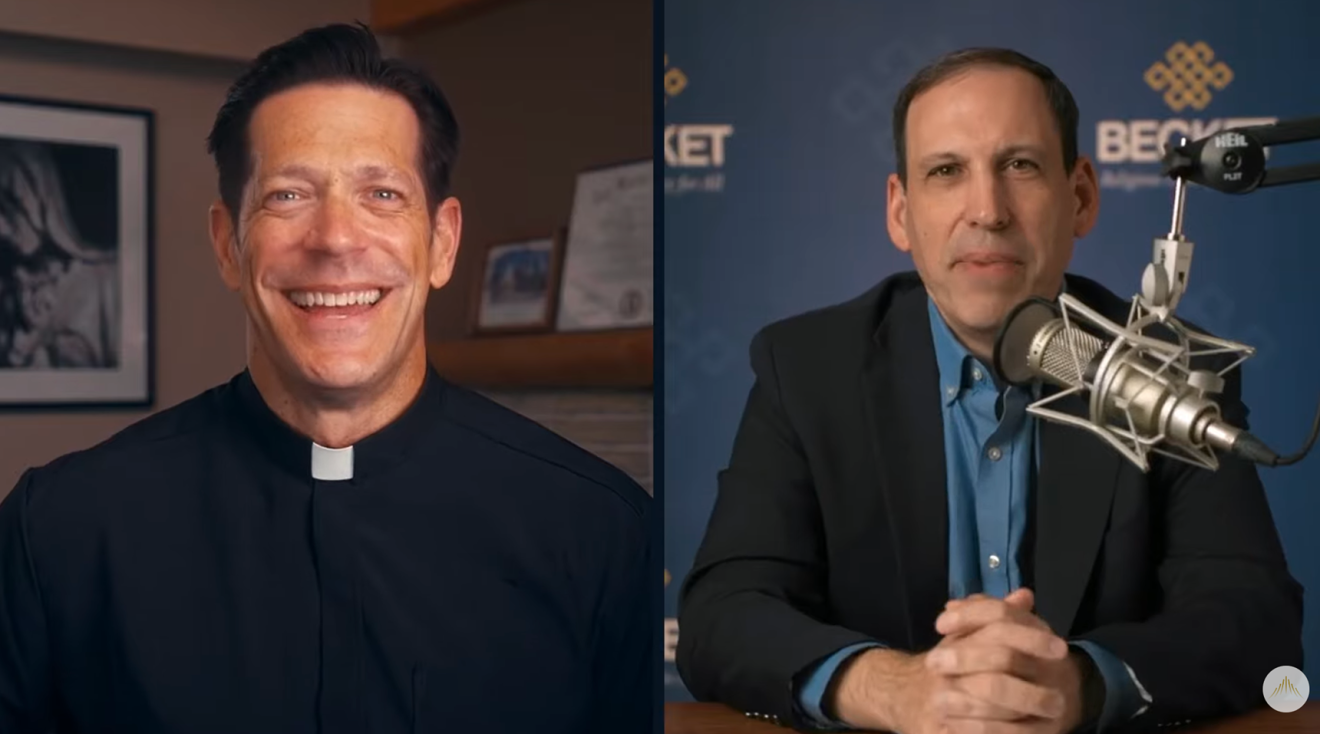
fr. mike schmitz interviewing Dr. Rienzi

How can the legal profession build up the kingdom of God? Mark Rienzi, law professor at The Catholic University of America, recently explored this question with Fr. Mike Schmitz on the popular “Called” podcast. 

The two discussed Rienzi’s lifelong work defending religious liberty, how his Catholic faith has shaped his career, teaching law students, and winning multiple high-profile Supreme Court cases.

Rienzi is president and CEO of the Becket Fund for Religious Liberty and co-director of the Center for Religious Liberty at Catholic University’s Columbus School of Law. He has been named the law school’s “Teacher of the Year” three times.

“I love Catholic University Law School; it’s invigorating and exciting to walk into a classroom…teach [students] about the law, and hopefully teach them to think about how to live out a vocation in the law,” Rienzi said. “Many, many of the students who come to Catholic are searching for that. They’re not just there to make money; they’re really there to take the skills they have and figure out how to use them to build God’s kingdom and make the world better.”

He told Fr. Schmitz that he had lost his first religious liberty case out of law school — until the case got to the Supreme Court of the United States 13 years later when he won. 

Today, the Becket Fund has an 85 percent win record and is the only non-profit, public-interest legal and educational entity in the United States that protects the free expression of all religious traditions.

Many, many of the students who come to Catholic University are searching for a vocation in law,” said Rienzi. “They’re not just there to make money; they’re really there to take the skills they have and figure out how to use them to build God’s kingdom and make the world better.”

That is important to Rienzi, who said, “If you honestly believe that every other human being is a beloved child of God, then I think you have to believe that God gave them freedom, and that they are supposed to be able to live out their faith and live out their life, and that the idea of the government stamping that out is a bad thing.”

He added: “All of our rights are interconnected, and so it would be a mistake, or it would be only doing half the job, to say I only want to stand up for the religious liberty of the guy who shares my beliefs.” 
Aligning Work with Faith: “Never Happier Professionally”

Rienzi has always had an interest in religious liberty, and his Catholic faith has guided him throughout his career. 

After law school, he joined a major law firm as an associate. 

His law firm experience gave him a solid foundation, but he said: “From the beginning, the reason I was attracted to these cases and to doing this kind of work was my Catholic faith. [Since making] it the main thing that I focused on all the time, I’ve kind of never been happier professionally, feeling I’ve aligned my use of my time and my use of my skills with what I think God wants me to bring to the world.”

While he has achieved major victories for clients like the Little Sisters of the Poor and Catholic Social Services in the Archdiocese of Philadelphia, so they could continue to provide ministry while living out their faith, he told Fr. Schmitz that doesn’t mean it’s always gone the way he wanted. 

“I feel pretty confident that I’m doing what God sent me here to do. I also feel confident I’m not supposed to be fully in control of it, and so when you hit the bumps to say: ‘Okay, it’s not how I would have written it, but I don’t have the pen. Just go back to doing the things you’re supposed to do.’”

Religious Liberty at 250

When Fr. Schmitz asked Rienzi how he would explain “why we need, in our great country, an organization dedicated to religious liberty,” Rienzi said he would start back at the beginning, when the United States was founded, 250 years ago. 

“Religious liberty and our First Amendment are kind of America’s original inventions for how we are all going to live together, despite the fact that we’re free to have different beliefs about really important things,” Rienzi said.

“In America, we have this idea that we’re going to be able to live together in peace with a real ‘live-and-let-live’ attitude that I’m allowed to live out my beliefs and pursue God the way I best understand Him, and within broad limits my neighbor is going to get to do that, too. I don’t need to make it illegal for my neighbor to have that belief. I don’t need my neighbor to get chased out of a job or have their life ruined because they’ve got different beliefs than mine. We could just peacefully coexist, even though we’re free to disagree about important things.” He added: “I think that’s something that America today really needs to discover and rediscover.”

“One thing that I’ve learned through my work at the Becket Fund is that it protects all sorts of things that are good and true and beautiful and wonderful in the world. Allowing people to live out their faith really gives so much good to our world …. It’s really an honor to get to protect that.”

Related News

  • The One and the Ninety-Nine cover art with sheep in the background

    Lost Sheep and Solid Selves: Luke Burgis on 'The One and the Ninety-Nine'

    Luke Burgis, assistant clinical professor of business in the Busch School, discusses the motivations behind his latest book, published June 16, 2026 by St. Martin's Press. "It isn’t a business book. It isn’t self-help. It’s a book for people who want to understand how a personal vocation can be lived in a world that might not understand it, and might even be actively hostile to your living it out."

  • Presenters at AI book talk meeting

    Can AI Ever Be Human?

    A June 11 campus conversation sparked by a new Catholic University of America Press book, Can AI Ever be Human? Consciousness Explored, turned into something far bigger: a wide-ranging dialogue about artificial intelligence, human dignity, and the soul of a new papal encyclical.

  • Students gather around laptops at hackathon event

    Unpacking Pope Leo XIV’s Encyclical, Magnifica Humanitas: Media Turn to Catholic University Experts

    From the BBC to The Washington Post, media have turned to artificial intelligence (AI) experts and ethicists at The Catholic University of America to explain the meaning and impact of Magnifica Humanitas: On Safeguarding the Human Person in The Time of Artificial Intelligence.